
Agentic AI is a loop, not magic: gather context, act with tools under permission, and verify before the next step. Treat it as a pipeline you can test and control with clear goals, safe tool surfaces, approvals, diffs-before-apply, sandboxing, and rollbacks.
Why Agentic AI is different from standard prompting
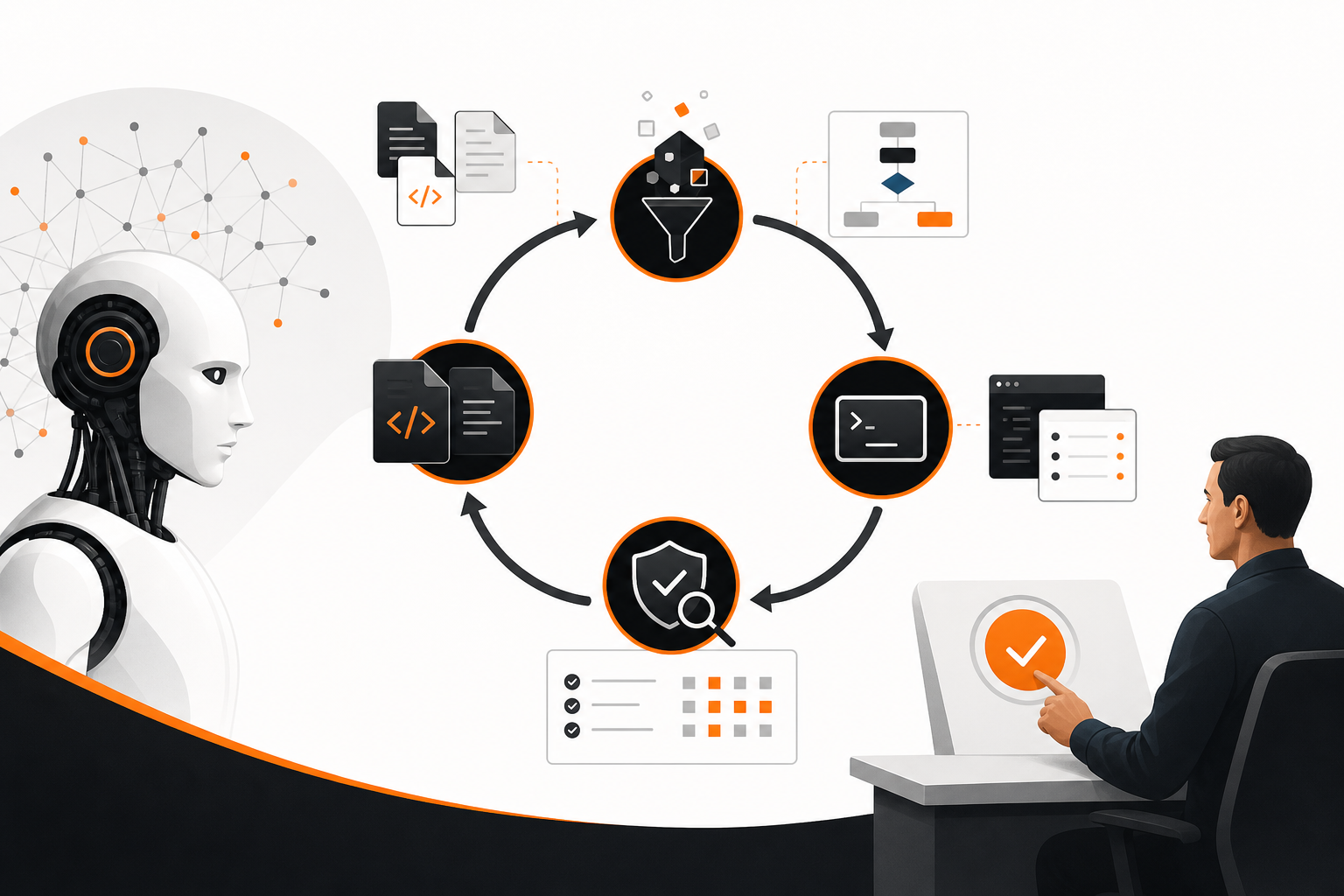
- Goal: A concrete, measurable target like 'refactor module X without breaking tests'.
- Tools: Constrained capabilities like read files, write files, run tests, call an API.
- Verification: Built-in checks to confirm each action made measurable progress without breaking constraints.
Definitions you can ship
- Agent: A model-driven controller that plans and invokes tools to reach a goal.
- Tool: A function, command, or integration that changes state (e.g., edit a file) or inspects it (e.g., run tests).
- Loop: A cycle of gather, act, and verify that ends when the success condition is met or the agent halts.
- Guardrail: Any mechanism that constrains tool use (policies, approvals, sandboxes, limits, and rollbacks).
What makes Agentic AI different in practice
- From answers to actions: The model proposes and executes changes via tools instead of only producing text.
- Measurable contracts: You can define pass/fail criteria (tests, lints, diffs) and block unsafe steps.
- Reproducibility: Because each step is logged, diffed, and gated, you can debug and replay.
The gather–act–verify loop, deconstructed
1) Gather
- Collect the objective, constraints, and relevant context (files, tickets, logs, API schemas).
- Summarize large contexts to fit in the window; fetch originals on demand.
2) Plan
- Produce a short plan with steps, tool calls, and success checks per step.
- Align plan with allowed tools and permission mode.
3) Act
- Invoke tools (read, write, run) under permission.
- Prefer idempotent, small, reversible changes.
4) Verify
- Run tests, static analysis, or custom checks.
- Compare actual vs. expected changes (diff size, performance budgets, error budgets).
5) Decide and iterate
- If checks pass and goal not yet met, continue; otherwise, propose a rollback or request help.
Measurable checks to bake in from day one:
- All tests pass (unit, smoke) before and after edits.
- Diff thresholds (e.g., < 400 added lines unless approved).
- No production endpoints or tokens used in sandbox.
- Runtime budgets (e.g., step < 60s, job < 10m) to avoid runaway loops.
- Logs include plan, tool arguments, results, and diffs for every step.
Inside Claude Code’s loop: what to copy

Context window strategy
- Repository awareness: Start with a file tree summary, key file excerpts, and dependency hints. Fetch full files on demand rather than inlining entire repos.
- Rolling context: Keep the latest diffs and test outputs in window; trim older noise but retain a persistent step log outside the window.
Tool invocation
- Read/write tools: Propose edits as structured diffs rather than free-form text to reduce ambiguity.
- Run tools: Execute 'run tests', 'build', or 'format' in a controlled shell with explicit arguments.
- Deterministic boundaries: Prefer tools with clear schemas and bounded outputs (e.g., JSON events, exit codes).
Permission modes you can mirror
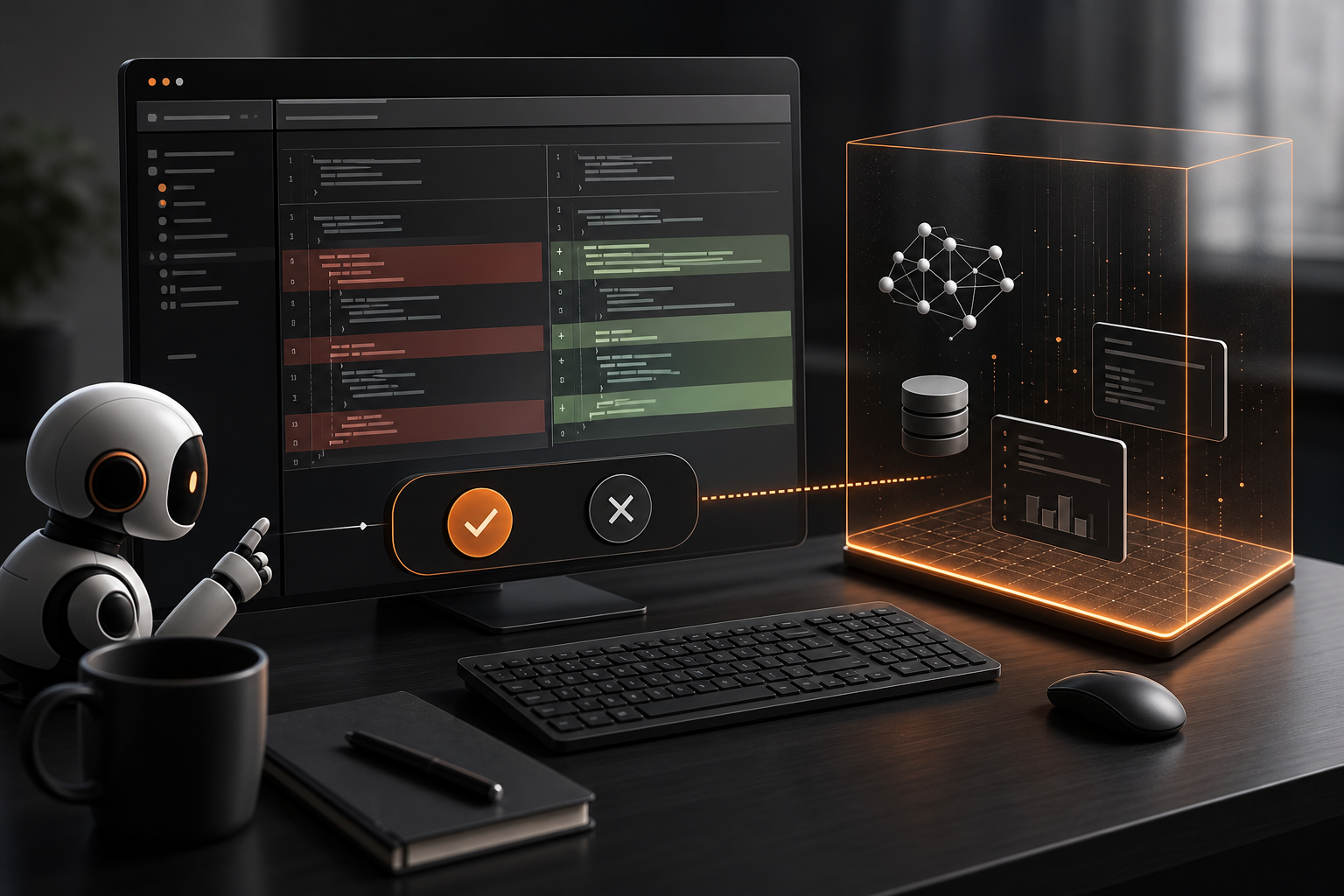
- Ask-to-run: The agent proposes actions; a human approves, rejects, or requests changes.
- Auto-within-policy: The agent can act automatically if the proposal matches predefined rules (e.g., only modify tests or docs).
- Escalate-on-risk: The agent pauses for review when diffs exceed thresholds, tools request network access, or secrets would be touched.
Result verification
- Checks-first: After each change, run tests and linters; if failures increase, suggest rollback.
- Diff-first UX: Always show diffs before applying to the working tree or main branch.
- Traceability: Keep a step-by-step log with the plan, tool calls, stdout/stderr, and the final outcome.
Example step sequence you can implement:
- Gather: Index file tree; load the target file and failing test output.
- Plan: 'Fix failing test by aligning function signature; run unit tests; keep diff under 50 lines; no new deps.'
- Act: Propose a patch; apply to a git worktree.
- Verify: Run 'pytest -q'; if failures drop to zero and lints pass, proceed; else revert patch and propose a new patch.
- Approve: Show diff and test summary; require human approval if touching non-target modules.
Mapping the same mechanics to Codex and Cursor

Codex (OpenAI)
- Codex-era systems primarily worked via code completion and prompt chaining, but the loop still applied when wrapped in tooling: extract context, propose edits, run tests, and verify.
- Without native function-calling at first, many teams enforced structure by diff-based proposals and shell wrappers to run checks. The lesson holds: do not let the model free-type changes into production; always diff and gate.
Cursor (IDE-centric agents)
- Cursor integrates the loop into the editor: it indexes your repo, proposes file edits as diffs, and can run commands in a terminal with permission prompts.
- Its agentic behavior benefits from IDE affordances: visible diffs, inline test results, and lightweight approvals ('apply changes', 'run command'), which mirror ask-to-run and diff-first practices.
The takeaway: whether you use Claude Code, a Codex-style wrapper, or Cursor’s IDE agent, the building blocks are the same—goals, tools, and verification—executed in a tight, inspectable loop.
From magic to pipeline: a reproducible action loop you can test
Here is a minimal, production-amenable process you can adopt.
1) Define the contract
- Goal: 'Add a feature flag to function A; default off; tests must pass.'
- Constraints: no external network calls; change only files in module X; diff < 200 lines.
- Success checks: unit tests pass; flag exposed via config; zero new linter errors.
2) Expose tools with schemas
- read_file(path)
- write_file(path, diff)
- run_tests(profile)
- run_lint()
- git_apply(patch), git_revert(commit)
- open_pr(branch, title, body)
3) Establish permission modes
- Auto: read-only tools and run_tests.
- Ask-to-run: write_file, git_apply.
- Escalate: any network request or diff > threshold.
4) Sandbox execution
- Use an ephemeral container or VM with a copy of the repo, test data, and limited permissions (no cloud IAM, no prod tokens). Tools run only inside this sandbox.
5) Log every step
- Plan, tool inputs, tool outputs, diffs, timings, exit codes.
- Store logs with a run ID to reproduce or audit.
6) Verify after each action
- Run tests and lints; compute diff size; check policy matches.
- If violations occur, revert and request approval or halt.
7) Ship with rollbacks
- Apply changes to a feature branch only.
- Open a PR with the plan and trace; include links to test runs and diffs.
- Allow one-click rollback by reverting the merge commit.
Minimal JSON tool contract example (language-agnostic):
{ "tools": [ {"name": "read_file", "args": {"path": "string"}}, {"name": "propose_patch", "args": {"path": "string", "patch": "unified_diff"}}, {"name": "run_tests", "args": {"profile": "string"}} ], "policies": { "max_lines_added": 200, "allowed_paths": ["src/module_x/"], "network": "deny" } }
Designing strong guardrails that don’t slow you down
Human-in-the-loop approvals
- Require approval for risky operations: multi-file edits, dependency changes, schema migrations, or diffs above threshold.
- Use quick prompts: approve, reject, request tweak; include test results snapshot and risk flags.
Sandboxing and scoping
- Isolate execution in containers or VMs with no access to production credentials.
- Mount code read-write but secrets read-only; deny outbound network by default.
- Limit CPU/memory/time to prevent runaway tasks.
Diffs-before-apply by default
- Always show a structured diff rather than unstructured text edits.
- Normalize formatting first (prettier/black/gofmt) so diffs capture intent, not whitespace churn.
Rollbacks and escape hatches
- Atomic changes: commit each step with a clear message; tag the run ID.
- Automatic reverts when checks regress.
- Keep a 'pause and ask' command that halts the loop for human guidance.
Measurable policy checks
- Diff limits, file path allowlists, dependency allowlists, and test profiles enforced per step.
- Track success metrics: pass rate, mean diff size, rollback rate, average approvals per task.
Limitations and how to work around them
No agent loop is perfect. Plan for these constraints.
- Context limits: Even long contexts cannot hold a full monorepo. Use summaries, file sampling, and on-demand fetch.
- Tool misbinding: The wrong tool called with the right intent yields bad outcomes. Keep tool schemas strict and validate arguments.
- Non-determinism: Model outputs vary. Reduce with clearer goals, smaller steps, and higher verification coverage.
- Long-running tasks: Break into subgoals, checkpoint state externally, and cap runtime per step.
- Quiet failures: Tooling may exit 0 with partial work. Prefer idempotent tools that return structured results, not just logs.
Evidence-led callout: what real tools converge on
- Ask-to-run permissions before shell or write operations.
- Diff-first editing as the primary UX primitive.
- Running tests and linters immediately after edits.
- Sandboxed execution with limited access to secrets.
- Logs that show proposal, action, and verification steps.
You can adopt these patterns today without guessing vendor internals—mirror the visible behaviors and gate them with your policies.
Putting it all together
If 'agentic AI' feels like magic, you can’t debug or trust it. Make the loop explicit. Define the goal and policies, expose narrow tools, require approvals, sandbox execution, verify after each action, and keep diffs and logs. Claude Code, Codex-era agents, and Cursor all demonstrate the same gather–act–verify mechanics. Turn that into your reproducible pipeline—and ship with confidence.
What is Agentic AI in software engineering terms?
Agentic AI is a model-driven controller that plans and invokes permissioned tools—like reading files, editing code, and running tests—in a repeatable gather–act–verify loop to achieve a measurable goal.
How does Claude Code implement the agent loop safely?
Claude Code exposes read/write and run tools, requests permission for risky actions, proposes structured diffs, and verifies with tests and linters. It emphasizes ask-to-run prompts, diff-first edits, and step-by-step logs.
Can the same loop work with Codex or Cursor?
Yes. Codex-era systems and Cursor’s IDE agent both map to gather context, propose diffed edits, run checks in a sandbox, and gate risky steps with approvals. The mechanics are universal across tools.
What guardrails are essential for Agentic AI in production?
Use human-in-the-loop approvals for risky changes, sandbox execution, diffs-before-apply, strict tool schemas, measurable policies (tests, lint, diff limits), and automated rollbacks with full step logs.