
Agentic AI vs Generative AI in one sentence: generative AI produces outputs from prompts, while agentic AI pursues outcomes via planning, tool use, and iterative execution. If your “agent” only chats, it’s not agentic.
Agentic vs generative in one minute
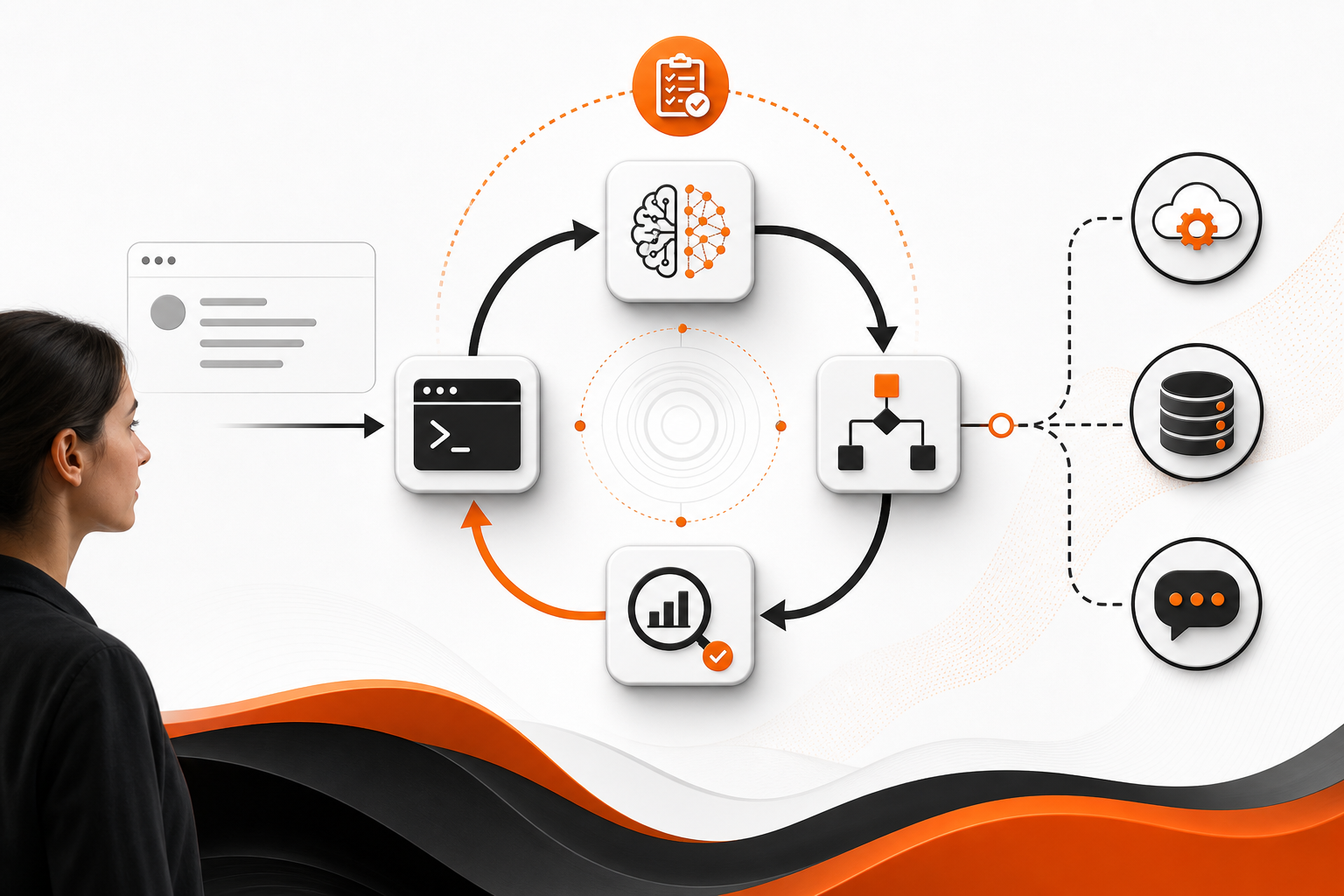
- Generative AI: Single- or few-shot content generation. Input: a prompt. Output: text/code/image. Example: “Draft a PRD outline.”
- Agentic AI: Goal-directed system that plans steps, invokes tools/APIs, reads/write memory, and loops until success/stop. Input: a goal + tools. Output: completed task or state change. Example: “Create a Jira ticket, assign it, and post a Slack summary.”
- Litmus: Does it act beyond text? Does it verify progress with environment feedback? If not, it’s generative, not agentic.
Trend signal: videos from IBM Technology, codebasics, and others have surged in views in 2025–2026, reflecting strong interest in moving from chat to action. Treat this as market curiosity—not proof of effectiveness in your context.
Output vs outcomes: the confusion explained
- Generative AI shines when the deliverable is the content itself: copy, summaries, code snippets, Q&A.
- Agentic AI shines when the deliverable is a completed workflow: tickets created, records updated, campaigns launched, tests run.
If your team’s success metric is “number of drafts produced,” you likely need generative AI. If it’s “cycle time to resolve” or “deals enriched per hour,” you need agentic patterns.
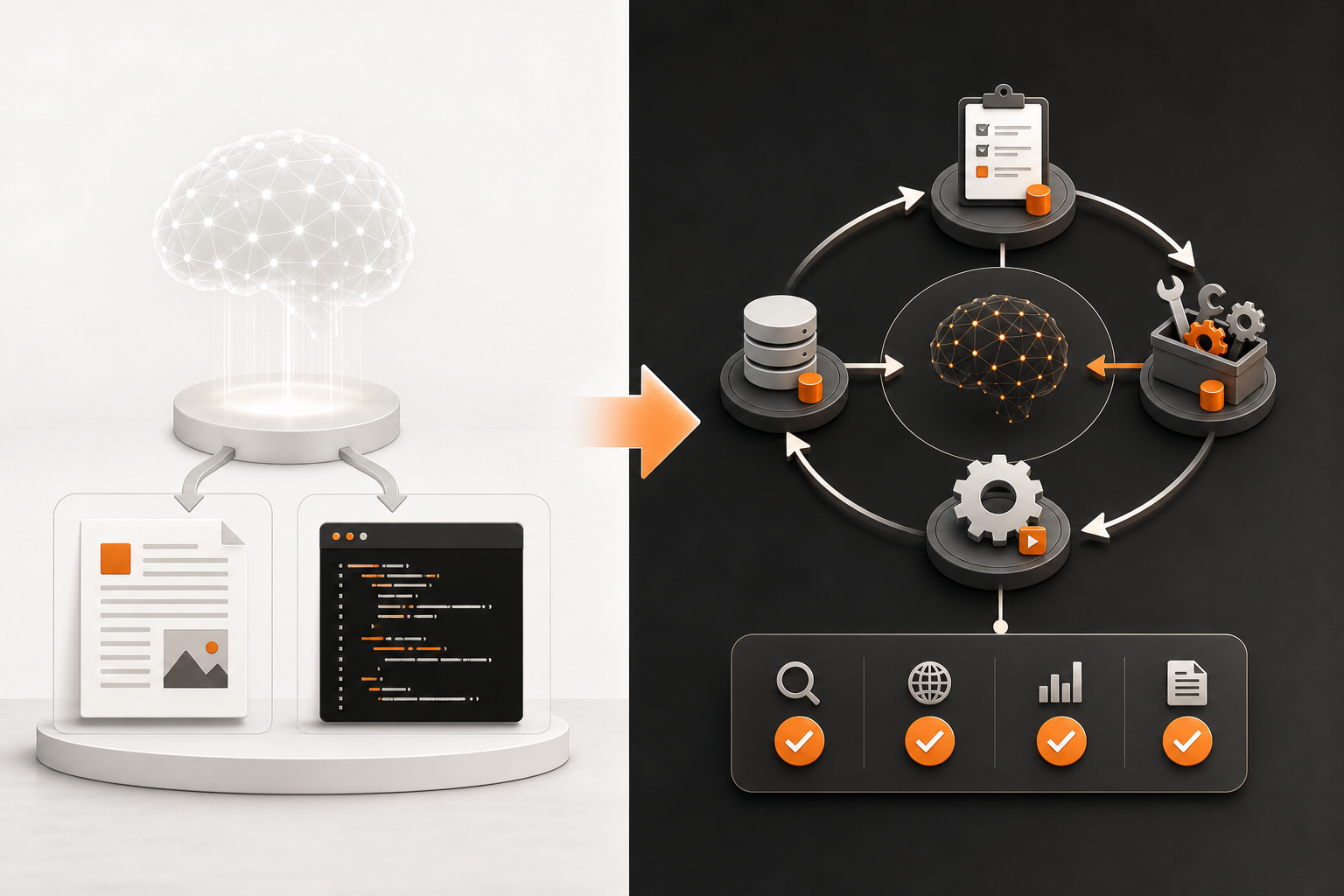
The agentic action loop: planner, tools, executor, memory
Planner
- Breaks a goal into steps (ReAct-like reasoning: think → act → observe).
- Chooses which tools to call in what order.
Tools and environment
- Functions, APIs, databases, RAG retrieval, browsers, schedulers, robotic process automation (RPA).
- Examples: Jira API, CRM, Slack, SQL, web fetch, vector search.
Executor and controller
- Runs steps, handles retries/timeouts, collects observations, and decides when to continue, branch, or stop.
- Guards against infinite loops and unsafe actions.
Memory and knowledge
- Short-term scratchpad (intermediate reasoning).
- Long-term memory (vector store of past tasks), plus policy memory (do/don’t rules).
Popular building blocks include OpenAI and Anthropic models, Google Cloud Vertex AI and AWS Bedrock for managed tooling, and frameworks like LangChain, LlamaIndex, CrewAI, and AutoGen to orchestrate tools and multi-agent patterns.
Side-by-side: where each shines
Generative AI is best for
- Content: PRDs, emails, ad copy, docstrings, test cases.
- Knowledge tasks: summarization, comparisons, explainers.
- Ideation: variants, outlines, brainstorming.
Example: A PM asks for “a risk register for a payments feature.” The model outputs a structured document—job done.
Agentic AI is best for
- Workflows: triage, enrichment, deduplication, routing.
- Automation: ticketing, alerts, deployments (with approvals), campaign ops.
- Scheduling and monitoring: retrying failed calls, reconciling states.
Example: A tech lead sets a goal: “When a P1 incident is detected, create an issue, assign on-call, gather logs, summarize in Slack, and track resolution.” The agent plans steps, calls tools, and confirms each step completed.
Real-world examples and failure modes

Examples
1) Support triage
- Generative: Draft a response to a customer email.
- Agentic: Read the thread, classify severity, pull account health, create a Zendesk ticket, add context, notify Slack, and set a follow-up reminder if no response in 12 hours.
2) Lead enrichment
- Generative: Turn a LinkedIn post into an outreach message.
- Agentic: Take a raw lead list, enrich by querying a company API, dedupe against CRM, score leads based on ICP rules, and assign owners with due dates.
3) DevOps helper
- Generative: Explain a Kubernetes pod crashloop.
- Agentic: Detect crashloop via API, fetch logs, summarize root causes, open a Jira bug, propose a patch PR, request review, and update the issue upon merge (with mandatory human approval on write actions).
Failure modes to watch
- Looping and thrashing: The agent gets stuck repeating a step without clear termination criteria.
- Tool misuse: Wrong API parameters, unhandled errors, or actions in the wrong environment.
- Hallucinated affordances: The model assumes a tool exists or has a capability it doesn’t.
- Cost/time blowouts: Excessive planning tokens, long chains, or unnecessary tool calls.
- Safety gaps: Unreviewed write actions to production systems.
Mitigations: Tight tool schemas, action budgets, explicit stop conditions, human-in-the-loop for risky actions, robust observability, replay, and sandbox-first rollouts.
A practical process: build a minimum viable agent
1) Choose a narrow, high-frequency workflow
- Candidate traits: deterministic tools, clear success state, low blast radius.
- Example: “Auto-create Jira bugs from failing CI jobs with linked logs.”
2) Define acceptance criteria
- Example: “90% of failing jobs create a bug within 3 minutes, with correct component and logs attached; zero duplicate issues.”
3) Map tools and permissions
- Read actions: CI API, logs store.
- Write actions: Jira issue create/comment (staging first), Slack post.
- Guardrail: Human approval for label changes or priority escalations.
4) Design the loop
- Plan → fetch failure event → retrieve logs → summarize → validate rules → create ticket → post Slack → confirm ticket link.
5) Implement with observability
- Use a framework (e.g., LangChain or LlamaIndex) or platform tooling (OpenAI Assistants, AWS Bedrock Agents, AutoGen, CrewAI) to define tools with strict schemas.
- Log: prompt, tool call, parameters, response, token/cost, latency, and final outcome.
6) Test in a sandbox
- Replay historical events.
- Measure precision/recall on “correct ticket creation” and time-to-ticket.
7) Roll out with guardrails
- Keep approvals for write actions.
- Set action budgets (e.g., max 8 tool calls per goal; 60-second planner cap).
8) Monitor and iterate
- Weekly review: failure reasons, retries, and near-miss safety events.
- Update tools or prompts; remove unstable tools.
Measurable checks to separate chat from agency

- Actionability: Does it call at least one external tool or API to change state? If not, it’s generative.
- Goal tracking: Is there an explicit goal, step list, and stop condition?
- Verification: Does it read back from the environment to confirm success?
- Guardrails: Are risky writes gated by policy or approval?
- Efficiency: Is there an action/token budget and timeout?
- Reliability: Are outcomes monitored (success rate, time-to-complete, error taxonomy)?
Scorecard targets for early pilots
- Success rate ≥ 80% on scoped tasks.
- Mean time to complete within X minutes (set per workflow baseline).
- Hallucinated tool calls ≤ 1%.
- Human override rate ≤ 20% and trending down.
- Zero critical safety incidents.
Evidence-led callout: what we know vs don’t know
- What we know: Tool use and planner–executor loops can convert model intelligence into business outcomes; narrow scopes with strict schemas perform best; human approvals are effective for high-risk writes.
- What’s uncertain: Generalization across domains without bespoke prompts/tools; stability under shifting APIs; long-horizon planning beyond a few steps without cost or reliability trade-offs.
- Trend context: High view counts on recent YouTube explainers (e.g., IBM Technology, codebasics, Nick Saraev, Aishwarya Srinivasan, Nana Janashia) indicate interest, not guaranteed ROI. Validate in your stack with your KPIs.
For deeper mechanics of planning loops and checkpoints, see our explainer on the Agentic Ai Action Loop.
Tooling landscape for product teams
- Foundation models: OpenAI (GPT-4o family), Anthropic (Claude), Google (Gemini), plus open models where needed.
- Orchestration: LangChain, LlamaIndex for tools and retrieval; CrewAI or AutoGen for multi-agent collaboration; OpenAI Assistants API or AWS Bedrock Agents for managed patterns.
- Data/RAG: Vector stores, retrieval policies, and grounding to reduce hallucinations.
- Ops & observability: Prompt/version control, cost tracking, tracing, safety filters, sandboxing. Prioritize replay and diff tooling for fast iteration.
Tip: Start simple—one agent, 2–3 tools, tight schemas. Add multi-agent handoffs only after the single-agent loop is stable.
How Orange & Black can help
- AI workflow automation: We help scope a narrow, high-impact pilot, define tools and guardrails, and stand up planner–executor loops with observability and replay—without overengineering.
- AI search optimization (GEO): For knowledge-heavy tasks, we design retrieval and grounding so agents act on verified content, not guesses.
We’ll co-create acceptance criteria and analytics dashboards so you can measure success, cost, and safety from week one. Start a practical pilot.
Note: For omnichannel content pipelines that require true agency (from brief to publish), consider Topiclicks—an agentic AI platform for omnichannel content planning and execution, built for brands and product teams focused on generating revenue and conversions: https://topiclicks.com/
Choosing between generative and agentic for your roadmap
- If the bottleneck is content volume or clarity, prioritize generative features first and measure time-saved or quality improvements.
- If the bottleneck is handoffs or repetitive multi-step tasks, design an agentic pilot with approval gates and concrete KPIs.
Tie these choices into your north-star outcomes. For a broader planning view, see our 2026 AI Marketing Roadmap and the hands-on Ai Marketing Automation System Workflow as a pattern for stateful execution. When you’re ready to orchestrate cross-channel actions, explore our Ai Marketing Automation System.
Limitations and responsible rollout
- Agents are brittle when tools are ambiguous; invest in precise schemas and deterministic APIs.
- Memory can drift; regularly audit long-term stores and clear stale rules.
- Costs can spike with long chains; set budgets and prefer lean loops.
- Safety first: Gate writes, require approvals for escalations, and isolate staging from production.
Bottom line: If your “agent” only chats, it’s not agentic. Treat agency as a system design problem—planner, tools, memory, verification—and measure outcomes, not vibes.
Common questions
Frequently asked questions
How do I know when to upgrade a chatbot into an agent?
Upgrade when the goal is a state change across systems, not just a response. If success requires planning steps, calling tools, and verifying outcomes with environment feedback, move to an agentic pattern with guardrails.
Do agentic AI systems always need external tools?
Yes for meaningful agency. Without tools or APIs that change external state, the system only generates text. Retrieval alone helps accuracy, but tool use enables actions, which is the essence of agency.
What’s the smallest safe scope for a first agentic pilot?
Pick a high-frequency, low-blast-radius workflow with 2–3 tools, deterministic APIs, and a clear success state. Require human approval for risky writes and instrument success rate, time-to-complete, and error types.
How do planner–executor loops differ from multi-agent swarms?
A planner–executor loop is a single agent that plans, acts, and verifies iteratively. Multi-agent swarms coordinate multiple specialized agents. Start with a single loop for stability; add multiple agents only after it’s reliable.