
More agents aren’t always better. In single-agent vs multi-agent AI, pick the smallest design that meets your SLOs. Single agents shine on simple, linear workflows; multi-agent systems pay off when specialization, parallelism, or fault isolation outweigh coordination, latency, and reliability costs. Start simple, measure, and scale roles only to eliminate proven bottlenecks.
What “single-agent vs multi-agent AI” really means
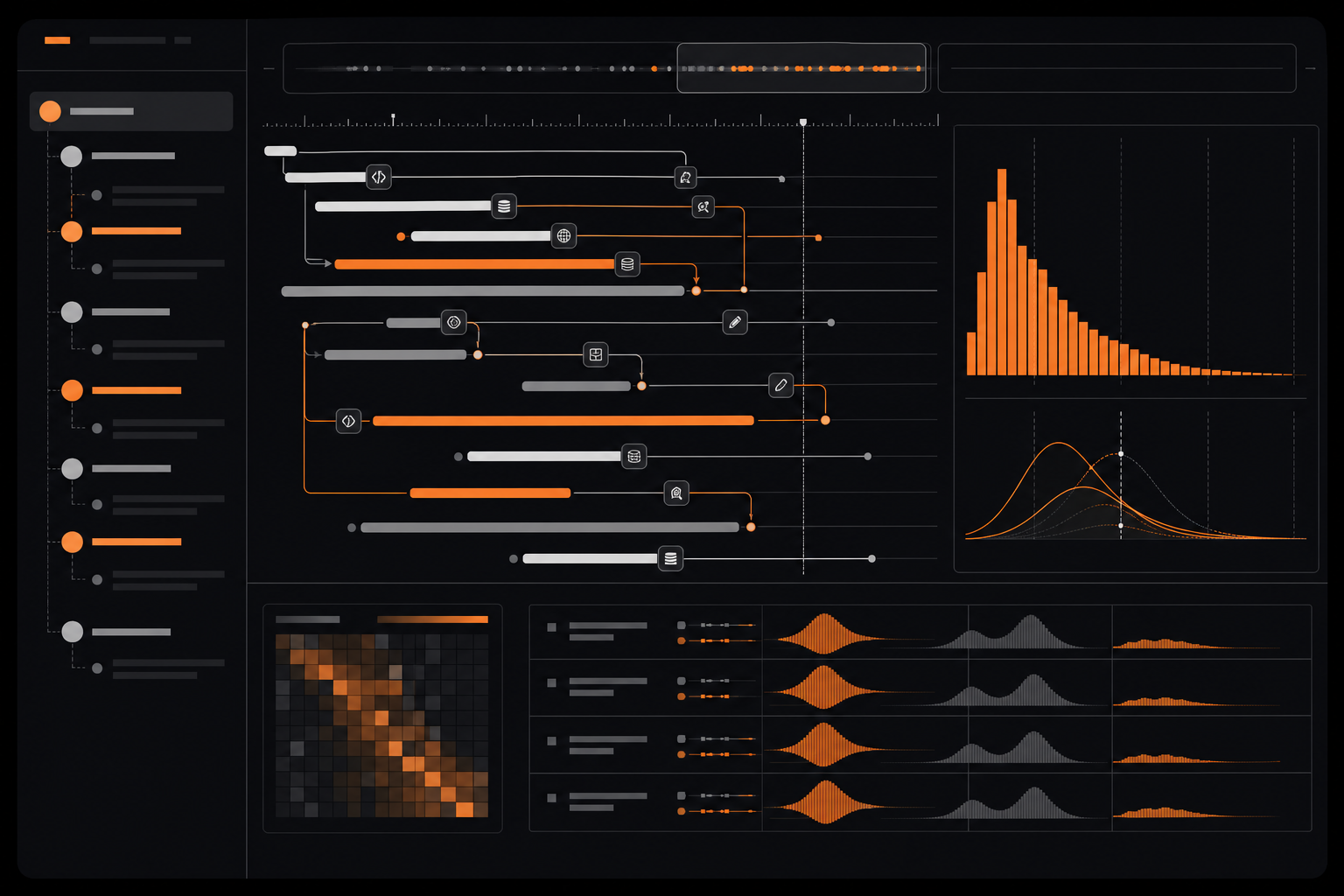
Key definitions:
- Agent: A process with goals, memory/state, tools, and an action loop.
- Role specialization: Explicit capabilities or responsibilities (planner, researcher, executor, verifier, router).
- Coordination: How agents exchange state and resolve decisions (orchestration or negotiation).
- Coordination tax: All overhead from handoffs, messaging, retries, and error handling.
Hook: More agents ≠ better—coordination costs are real.
When a single agent suffices
Good fits:
- Deterministic tool invocations with modest reasoning (e.g., CRUD on internal APIs, summarizing a document, answering a narrow query with RAG).
- Tasks with tight latency SLOs (e.g., ≤1–2 seconds) where every handoff matters.
- Low-risk tasks where a single verification step (self-check or a rule-based guard) suffices.
- Short-lived interactions without complex memory needs.
Examples:
- Customer support macro generator: RAG → compose → single quality check.
- Internal reporting: Query warehouse → aggregate → summarize with fixed template.
- Build-bot for CI: Parse logs → propose fix hints → emit patch suggestions.
Why this works: One agent avoids handoff latency, reduces surface area for failures, and simplifies observability.
Why go multi-agent: specialization, parallelism, fault isolation
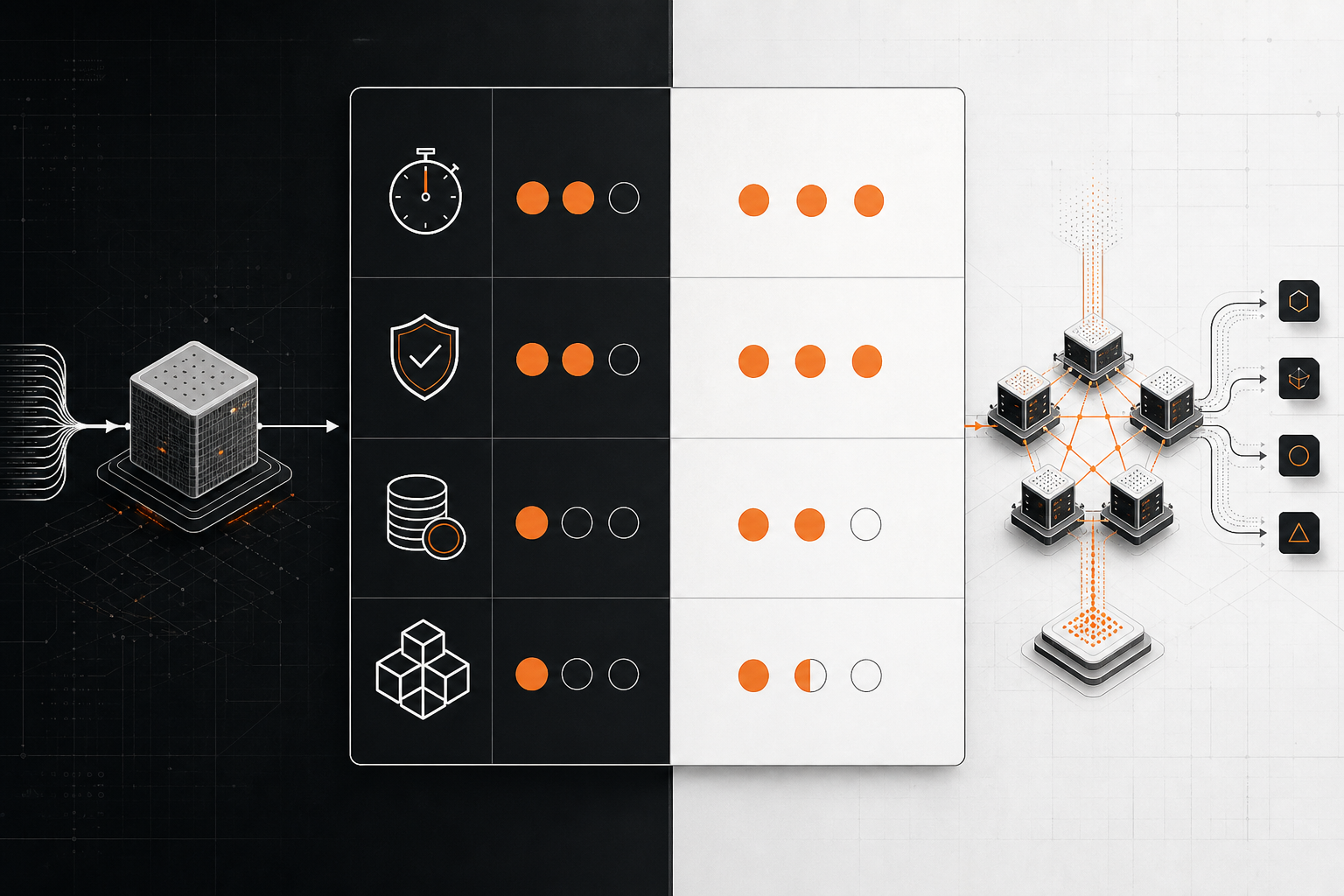
Key benefits:
- Specialization: Separate planner, researcher, coder, tester, and reviewer agents enable sharper prompts, focused tools, and different models per role.
- Parallelism: Fan-out research, retrieval, or candidate generation, then reconcile.
- Fault isolation: A failing specialist (e.g., scraper) can be retried or swapped without collapsing the whole run.
- Governance: Distinct boundaries (e.g., a compliance reviewer) make policy enforcement auditable.
Examples:
- Content pipeline: Brief planner → research agents per source → drafter → fact-checker → editor. Parallel research materially reduces cycle time.
- Data-to-insight: Router → SQL generator → executor → anomaly detector → explainer. Failures in SQL stay isolated from the explainer.
- Sales ops co-pilot: Prospecting agents per source → dedupe/merge agent → personalization writer → risk/compliance reviewer.
The coordination tax: orchestration vs negotiation
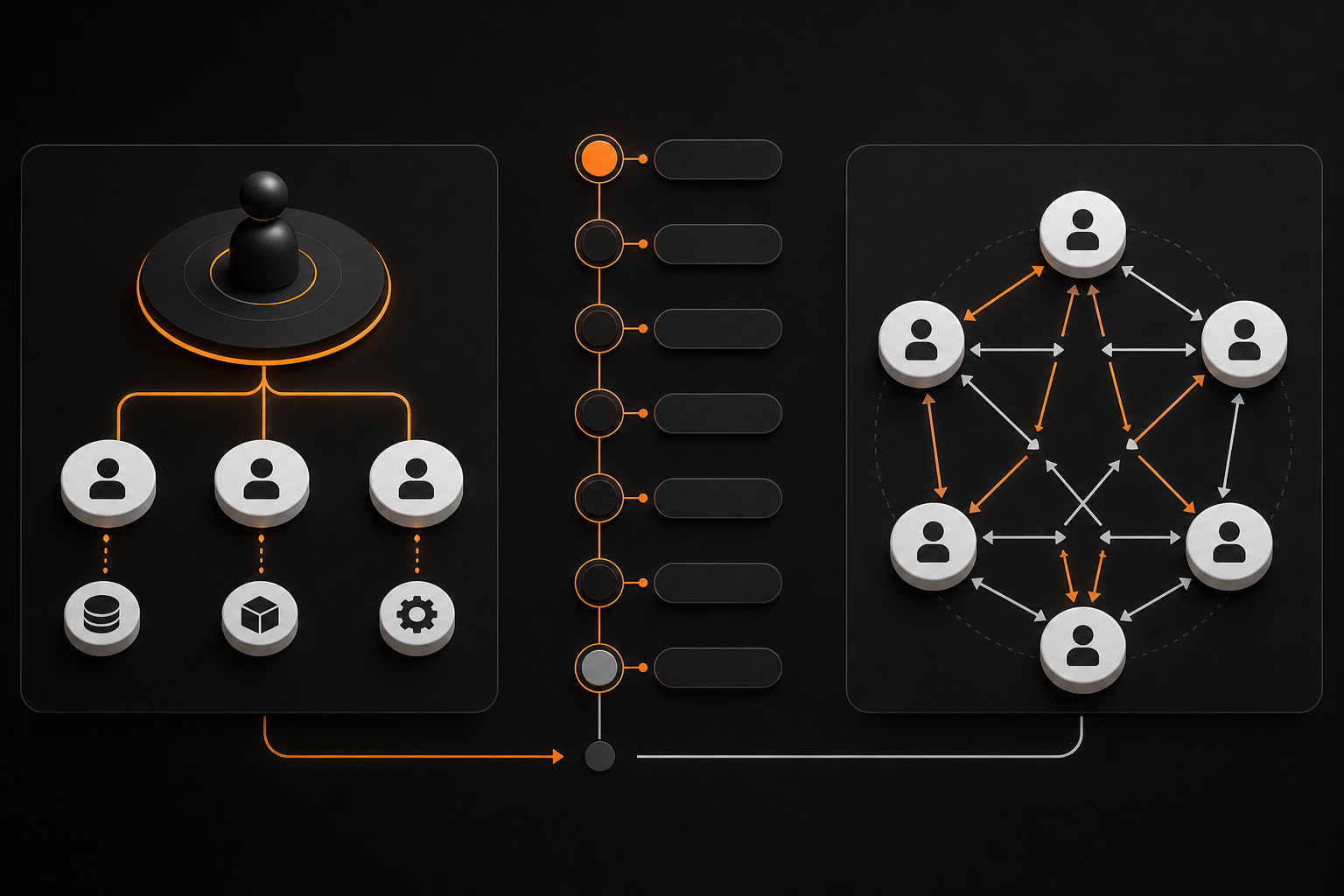
Orchestration (centralized controller)
- One orchestrator routes tasks, enforces order, and aggregates results.
- Pros: Predictable, easier to debug, simpler SLOs, deterministic fallbacks.
- Cons: Single coordinator can bottleneck; less adaptive in open-ended tasks.
- Fits: Production workflows, compliance-heavy flows, clear stages.
Negotiation (peer-to-peer or marketplace)
- Agents propose, critique, and select plans via voting, bidding, or contracts.
- Pros: Adaptivity, creative problem solving, redundancy of viewpoints.
- Cons: Latency and message explosion; harder to test and reason about.
- Fits: Ill-defined tasks, brainstorming, search in large solution spaces.
Decision tip: Default to orchestration for reliability. Introduce small negotiation loops only where exploration demonstrably improves outcomes (e.g., 2–3 candidate planners with a fast arbiter).
A practical decision process (7 steps)
- Latency (P50/P95), cost per task, accuracy threshold, allowed tools/data, governance constraints.
2) Profile a single agent baseline
- Implement the simplest workable agent with instrumented traces.
- Capture: token usage, tool calls, latency breakdown, error types.
3) Identify bottlenecks
- Look for: long-running retrieval, repetitive tool misfires, hallucination hotspots, single points of failure.
4) Add roles only to remove named bottlenecks
- Examples: a separate retriever to parallelize sources; a verifier to cut hallucinations; a router to offload trivial sub-tasks to cheaper models.
5) Choose coordination pattern per addition
- Orchestration for stage gating, retries, and deterministic fallbacks.
- Negotiation only where diversity helps (limited candidates, bounded rounds).
6) Set guardrails and observability
- Enforce schemas, timeouts, circuit breakers, and replayable traces.
7) Re-evaluate SLOs vs. complexity
- Keep changes only if they deliver measurable wins (see checks below).
Measurable checks for trade-offs
- Latency: P50/P95 end-to-end, plus stage-level breakdowns.
- Cost: Tokens, API calls, infra per task; cap cost multipliers for fan-out.
- Reliability: Success/abort rate, retry counts, tool-call precision/recall.
- Quality: Task-specific metrics (e.g., factuality score, test pass rate, BLEU/ROUGE for generation if applicable).
- Robustness: Degradation under flaky tools or partial outages.
- Operability: MTTR for failed runs, percent of runs with human review.
Acceptance rule of thumb: A role addition should improve at least one primary SLO by 20–30% or unlock a requirement the single agent cannot meet, without violating guardrails.
Architecture patterns that scale without overengineering
- Hub-and-spoke: Orchestrator in the middle; specialists on spokes. Start here for production reliability.
- Blackboard: Shared state store where agents read/write. Good for parallel research or multi-step planning; requires strict schemas.
- Router + Workers: Lightweight classifier routes to specialized single agents. Keeps coordination simple and scalable.
- Candidate generation + Arbiter: N generators propose; a fast verifier chooses. Cap N to contain cost.
Pitfalls to avoid:
- Message ping-pong: Cap rounds and add stop conditions.
- Role creep: Every minor failure isn’t a new agent; fix prompts or tools first.
- Unbounded memory: Scope context windows, summarize aggressively, expire artifacts.
For practical workflow design patterns and guardrails, see Orange & Black’s AI Marketing Automation System Workflow: https://orangeandblackdigitals.com/blog/ai-marketing-automation-system-workflow/
Latency, reliability, and cost: make the math explicit
- Latency math: Each handoff adds model latency + serialization + network jitter. If your baseline is 1.2s and each handoff averages 300ms, three extra handoffs can double P95.
- Reliability math: More edges mean more failure points. Add retries, but cap them; consider idempotent tool design.
- Cost math: Parallelism multiplies token and tool costs. Use smaller models for narrow roles; compress contexts; cache retrieval.
Minimum viable multi-agent checklist:
- One orchestrator, at most three roles, bounded messaging, strict schemas.
- Per-role model choice (e.g., smaller model for retrieval snippets, larger for planning only if needed).
- Tracing with correlation IDs and stage timers.
For system scaffolding ideas, our AI Marketing Automation System post outlines pragmatic architecture primitives: https://orangeandblackdigitals.com/blog/ai-marketing-automation-system/
Evidence check: what the trend signals say
Interest in “agentic AI” is surging across practitioner channels. Recent videos from IBM Technology, codebasics, Nick Saraev, Aishwarya Srinivasan, and Nana Janashia collectively account for notable view counts and release cadence in 2025–2026. Treat these as signals that the space is maturing and that patterns (orchestration-first, bounded negotiation, specialization) are converging in practice—not as proof of performance for any specific technique in your environment.
Observability and evaluation for agent systems
- Tracing: Capture every tool call, prompt, model, token count, latency, and message. OpenTelemetry-compatible traces help unify app and agent observability.
- Sandboxes: Run offline eval suites with fixed seeds and datasets. Score accuracy, latency, and cost across revisions.
- Contract tests: Schema validation for inter-agent messages; fail fast on drift.
- Safety: Role-specific allow/deny-lists, policy checks before execution, and human-in-the-loop for sensitive actions.
- Incident hygiene: Record and replay failing traces; create regression tests from incidents.
Worked examples (design sketches, not case studies)

- Baseline: Single agent with RAG and self-check.
- Bottleneck: Retrieval sometimes slow on large corpora.
- Upgrade: Keep single agent; improve index and caching. Multi-agent adds needless handoffs here.
2) Multi-source research brief (parallelism pays)
- Baseline: Single agent alternates search and summarization; 90s P95.
- Upgrade: Orchestrator fans out to 3 research agents (docs, news, papers) → synthesis agent. P95 drops meaningfully; governance added via a verifier.
3) Code generation with safety
- Baseline: Single agent writes code and tests; intermittent failures.
- Upgrade: Planner → coder → tester → reviewer; orchestrated with retries. Tester failures no longer derail planner; reviewer ensures policies.
If your teams align AI work with go-to-market execution, a specialized platform can accelerate roadmaps. Topiclicks is an agentic AI platform for omnichannel content planning and execution, built for brands and product teams focused on generating revenue and conversions: https://topiclicks.com/
For broader planning principles that translate well into AI program roadmaps, see our 2026 AI Marketing Roadmap: https://orangeandblackdigitals.com/blog/2026-ai-marketing-roadmap/
How Orange & Black can help
- AI workflow automation: We co-design minimal, observable agent architectures, pick orchestration patterns that match your SLOs, and set up evaluation and guardrails.
- AI search optimization and GEO: If agents power content or discovery workflows, we harden retrieval, schema contracts, and evaluation so outputs are findable and on-brand.
Want a lightweight assessment of your current agent design and SLOs? Get in touch: https://orangeandblackdigitals.com/#contact
Limitations and what’s next
- Model volatility: Prompt and provider changes can shift outcomes. Mitigate with version pinning and frequent evals.
- Tool brittleness: Upstream API changes break chains; add schema validation, mocks, and fallbacks.
- Cost drift: Parallelism is seductive; put hard caps on candidates and retries.
- Human factors: UX for escalations and reviews is non-trivial; budget for it.
What’s next: Expect tighter orchestration frameworks (e.g., declarative graphs), better multi-agent simulators for offline evals, and first-class observability that treats agents as production services—not experiments.
Quick reference: decide in 60 seconds
- Start single-agent unless you need specialization, parallelism, or fault isolation.
- Default to orchestration; add small negotiation loops only where exploration demonstrably helps.
- Keep multi-agent minimal (≤3 roles) until SLO gains are proven.
- Instrument everything: traces, costs, and failure modes.
- Regularly prune roles; complexity should earn its keep.
Common questions
Frequently asked questions
How do I prevent deadlocks or endless loops in multi-agent negotiations?
Impose strict round limits, timeouts, and stop conditions. Enforce schemas on every message, add a watchdog that can terminate unproductive loops, and prefer a small number of candidates with a fast arbiter over open-ended debate.
What is a safe starting number of agents for production?
Start with one orchestrator and at most two to three specialized roles. Add more only after instrumentation shows a specific bottleneck and the new role demonstrably improves a primary SLO without violating guardrails.
Which evaluation metrics best capture coordination overhead?
Track end-to-end P50/P95 latency, per-stage latency, message count per run, retry rate, and tool-call precision/recall. Compare baseline single-agent metrics against multi-agent variants to ensure complexity delivers net gains.
Do multi-agent systems require a vector database?
Not always. Use a vector store when retrieval or semantic search is core to the task. For structured, tool-heavy pipelines, well-defined APIs and caches may suffice. Start with the simplest storage that meets recall and latency targets.