
International SEO aligns your site architecture, hreflang, and localized content so the correct page ranks per country and language—across Google and AI Overviews. The 2026 playbook: pick the right structure (ccTLDs, subdirectories, or subdomains), deploy reciprocal hreflang, localize beyond translation, load fast in each region, and track performance per market in GSC and GA4.
If you’re asking “what is international seo,” it’s the practice of matching search intent and delivery per country/language. If you’re thinking “international seo how to do that,” use the framework below to avoid cannibalization and maximize local wins.
What international SEO means in 2026
International SEO is the discipline of structuring, signaling, and localizing your web presence so search engines return the right version for each market. In practice, that means:
- Selecting the best domain architecture for your goals
- Implementing hreflang correctly (reciprocal, canonical-aligned)
- Serving localized content, offers, and compliance
- Shipping fast, stable pages in-region
- Measuring visibility and conversion per locale
Why it matters now: AI Overviews and feature-heavy SERPs raise the bar on intent match and entity clarity. Misaligned structures and missing hreflang cause wrong-language rankings, duplicate content issues, and budget waste.
Evidence-led callout
- Google’s guidelines specify hreflang should be bidirectional and point to self-canonical pages. Mismatches often surface wrong pages per locale.
- ccTLDs can send clearer geo signals but split link equity; subdirectories consolidate equity but rely more on hreflang and content cues.
- Core Web Vitals and stable rendering remain ranking and UX factors; track them by country for real-world users.
Market selection and intent mapping by country/language
- Demand sizing: Use keyword tools by country/language; group by solutions, brand, and category. Layer in seasonality and logistics feasibility (shipping, VAT, payment rails).
- SERP features: Snapshot the SERP per locale. Identify AI Overviews presence, local packs, shopping carousels, top aggregators, and non-English dominant players.
- Competitor landscape: Note domain structures your top competitors use. Assess content depth, link velocity, and localization quality (pricing in local currency, support hours, policies).
- Language vs country: Decide whether to target language (es) or country-language (es-ES vs es-MX) based on intent and product-market fit.
Measurable checks
- Top 10 intents per market mapped to landing pages
- Estimated traffic/revenue upside vs logistics cost
- A go/no-go threshold (e.g., minimum addressable demand, CAC/LTV fit)
Architecture: ccTLDs vs subdirectories vs subdomains
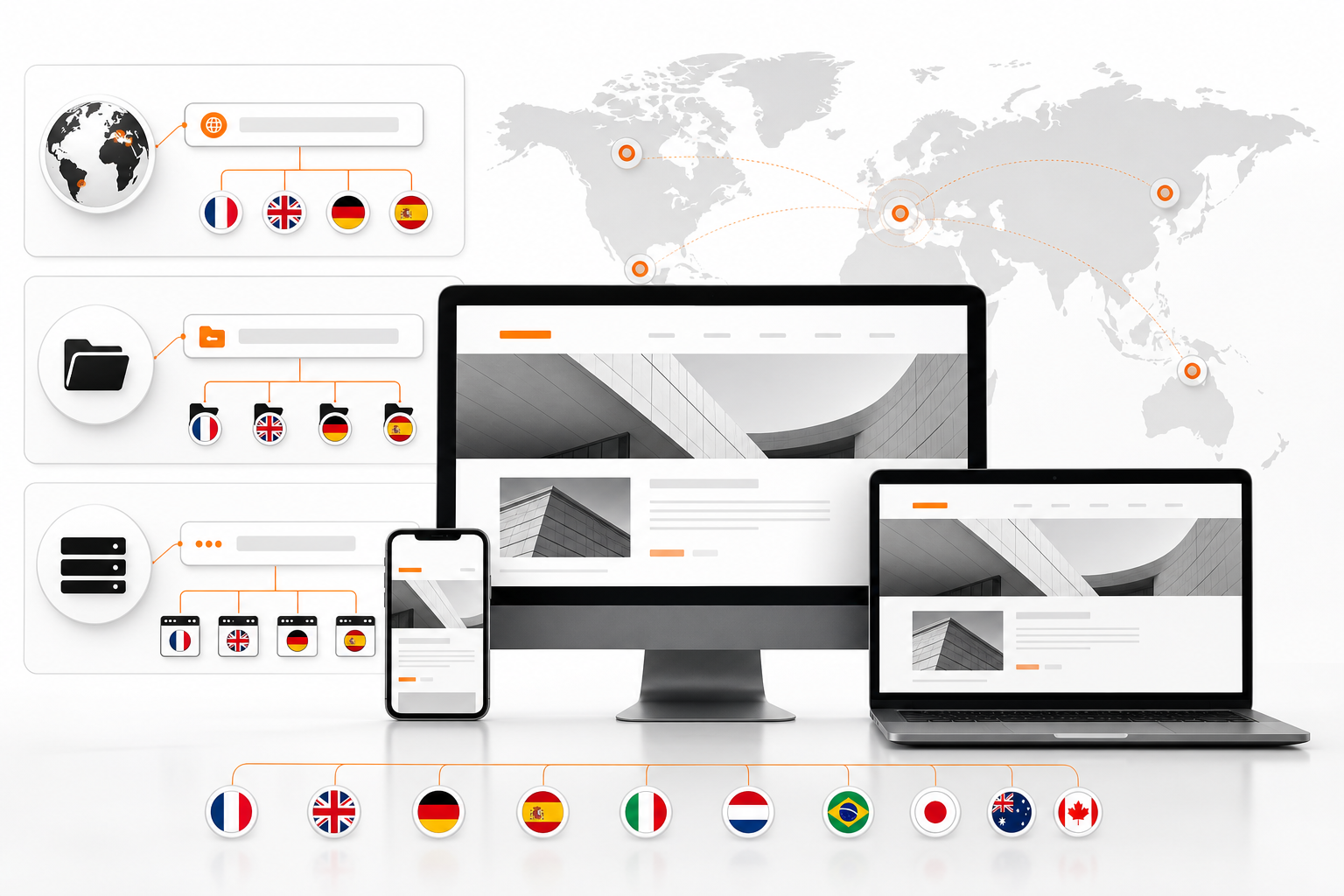
ccTLDs (example.fr, example.de)
Pros
- Strongest country signal
- Higher user trust in some markets
- Legal/compliance separation can be simpler
Cons
- Splits authority across domains
- Higher overhead to maintain
- Link building required per domain
Use when
- You have significant resources and market-specific teams
- Regulatory or brand reasons favor a local domain
- The market is large enough to justify separate authority building
Subdirectories (example.com/fr-fr/)
Pros
- Consolidated authority and crawl budget
- Easier to manage at scale
- Faster to enter multiple markets
Cons
- Relies heavily on hreflang and content signals
- Weaker country trust in certain regions vs ccTLDs
Use when
- You want fastest route to scale with limited resources
- Your primary market domain is authoritative
- Markets are medium-sized or you test-and-learn entry
Subdomains (fr.example.com)
Pros
- Operational separation without new domains
- Flexible DNS/CDN routing per region
Cons
- Often treated more like separate sites for authority
- Easy to drift in governance and UX
Use when
- You need infrastructure separation (e.g., apps) but want brand continuity
- You can still centralize governance and internal linking
Measurable checks
- Forecast organic share and time-to-rank under each structure
- Infrastructure and governance cost per option
- Required backlinks to reach parity with top 3 competitors
URL patterns, language codes, and slug hygiene
- Use ISO 639-1 for language (en, fr, de) and ISO 3166-1 alpha-2 for country (US, FR, DE) where needed. Example: /fr-fr/, /en-gb/, /es-mx/.
- Keep lowercase paths; avoid diacritics in URLs even if used in on-page copy. Prefer transliteration for slugs.
- One locale per URL; no parameter-based language switching for indexable pages.
- Canonicals should be self-referential within each locale variant; do not canonicalize en-GB to en-US.
- If using geotargeting in Search Console, only apply it to subdirectories or subdomains dedicated to a single country.
Examples
- Subdirectory: https://example.com/de-de/produkte/kaffee
- ccTLD: https://example.de/produkte/kaffee
- Subdomain: https://de.example.com/produkte/kaffee
Measurable checks
- 100% of locale URLs follow a validated pattern
- Zero mixed-language pages within a single locale path
- Canonical and hreflang targets match exactly by protocol, host, and path
Hreflang: the clean implementation that scales

- Declare reciprocal pairs across all locale versions, including self-references
- Align hreflang to the canonical URL of each page
- Use region-specific codes only where needed (e.g., fr-CA, pt-BR)
- Provide an x-default for global fallbacks (e.g., /en/ or /global/)
- Prefer XML sitemap hreflang for large sites; HTML tags are fine for small sets; HTTP headers for non-HTML assets
Common errors to avoid
- Missing reciprocity (page A -> B, but B -> A missing)
- Pointing to non-canonical URLs or redirects
- Mixing language and region incorrectly (e.g., en-EU is invalid)
- Duplicate content without clear differentiation (price, shipping, legal, offers)
Testing and monitoring
- Validate with a sitemap-level hreflang report
- Spot-check in Search Console International Targeting reports or URL Inspection
- Monitor impressions-to-clicks anomalies where wrong-language pages receive impressions
Measurable checks
- 99% reciprocity across mapped locale pairs
- 0 redirecting hreflang targets
- Declared x-default present where strategy requires
Localized content that wins (beyond translation)
- Offers and compliance: Local currency, VAT/GST handling, shipping options, returns policy, support hours, and legal pages
- Copy and UX: Native idioms, date/time formats, imagery that matches local context, units of measure
- Product-market nuance: Catalogue differences by region, payment methods (e.g., iDEAL, Boleto), and pricing psychology
- Signals: Local testimonials, case studies, local press mentions, and partnerships
Technical helpers
- Segment sitemaps by locale for targeted crawl signals
- Use structured data in each language (e.g., Product, Organization), ensuring in-language fields
- Connect to local entities (addresses, if relevant) and ensure consistent NAP on site and major directories
Measurable checks
- Unique title/meta per locale; no machine-translation leftovers
- Click-through rate uplift on localized SERP snippets
- Conversion rate parity vs home market after logistics normalization
Technical essentials for speed and AI Overviews readiness

- Performance: Optimize Core Web Vitals by region (CDN footprint, image formats, font delivery, JS hydration). Track by country in Real User Monitoring.
- Structured data: Maintain accurate, localized schema; include in-language names, offers, and availability where relevant.
- Content clarity: Short, answer-first sections and entity-rich copy improve how summarization systems understand your pages.
- Media: Provide alt text in-language; ensure captions and transcripts for videos.
Measurable checks
- 75th percentile LCP < 2.5s per major market
- Valid structured data coverage > 95% for key templates
- Featured snippet or short-answer coverage for target intents per locale
Measurement and governance per market
- Search Console: Create domain-level plus per-locale properties (e.g., https://example.com/fr-fr/). Monitor queries, coverage, and enhancements per region.
- GA4: Implement cross-domain or roll-up as needed. Report by locale path/subdomain and currency.
- Dashboards: Segment rankings, clicks, conversions, and site speed by country-language.
- Governance: Maintain a locale inventory, owners, SLA for content updates, and a playbook for migrations.
Tip: For omnichannel content planning and execution, consider an agentic AI platform like Topiclicks to map intent clusters by market, coordinate localization briefs, and push approved variants to your CMS. Use it to augment, not replace, editorial judgment.
Measurable checks
- Per-locale GSC properties live with alerts
- Weekly anomaly detection on wrong-language impressions
- Quarterly content freshness audit per market
How Orange & Black can help
If you’re expanding to five or fifteen markets, we help you ship the right architecture, not just “translate the site.” Our team designs your domain/URL model, implements hreflang at scale (sitemaps, QA, monitoring), and localizes key templates with market-ready offers and schema. We build per-locale dashboards in GSC/GA4, define governance, and support migrations with risk controls. When needed, we collaborate with your developers on CDN routing, Core Web Vitals by country, and structured data localization—so you launch fast and measure what matters.
Limitations, risks, and rollout sequencing
- Risk areas: Authority dilution across domains, hreflang errors, thin translation, redirects in hreflang targets, and geo-IP auto-redirects that block crawlers.
- Legal/compliance: Cookie consent, VAT/GST, consumer rights differ; align before launch to avoid takedowns or trust loss.
- Sequencing: Pilot in one to two markets using your chosen structure. Validate crawl/indexation, performance, and conversion before scaling.
Risk controls
- Pre-launch staging validation of canonicals/hreflang
- XML sitemaps per locale enabled before go-live
- 301 redirect maps tested for any moved URLs
The 30-60-90 day international SEO plan

- Select markets and map top intents to target pages
- Choose architecture; define URL patterns and language codes
- Draft hreflang model and sitemap segmentation
- Build per-locale GSC properties; set GA4 reporting
60 days: Content and technical implementation
- Localize top 50–200 pages per market (copy, offers, schema)
- Implement hreflang in sitemaps; ship x-default if used
- Optimize Core Web Vitals with CDN and image strategy per region
- QA: reciprocity, canonicals, and no mixed-language pages
90 days: Launch, measure, and iterate
- Roll out two priority markets; monitor coverage and rankings
- Fix wrong-language impressions; tune internal linking per locale
- Expand to next markets once KPIs hit (CTR, conversion rate, LCP)
Success looks like
- Correct-language rankings per market with rising CTR
- Stable or improved Core Web Vitals across locales
- Measurable revenue contribution from each new market
Common questions
Frequently asked questions
Do I need hreflang if I use separate ccTLDs for each country?
Yes. ccTLDs send strong geo signals, but hreflang still helps search engines serve the correct language/country variant and avoid cross-market duplicates, especially where multiple languages exist within a country or where brand/UX similarities cause ambiguity.
Should I target language-only (e.g., es) or country-language (e.g., es-ES, es-MX)?
Use country-language when intent, pricing, compliance, or vocabulary differs by country. Use language-only when the offer and terminology are truly uniform across regions and you lack resources to manage multiple variants.
Is geo-IP redirection OK for international SEO?
Avoid automatic redirects that block crawlers or users. Prefer a soft locale selector banner and allow access to all versions. If you must redirect, never apply it to Googlebot and always provide an easily discoverable way to switch locales.
How many markets should I launch at once?
Pilot one to two markets first. Validate hreflang, indexing, performance, and conversion. Once KPIs stabilize, scale in waves. This reduces migration risk and ensures your governance and content workflow can keep pace.